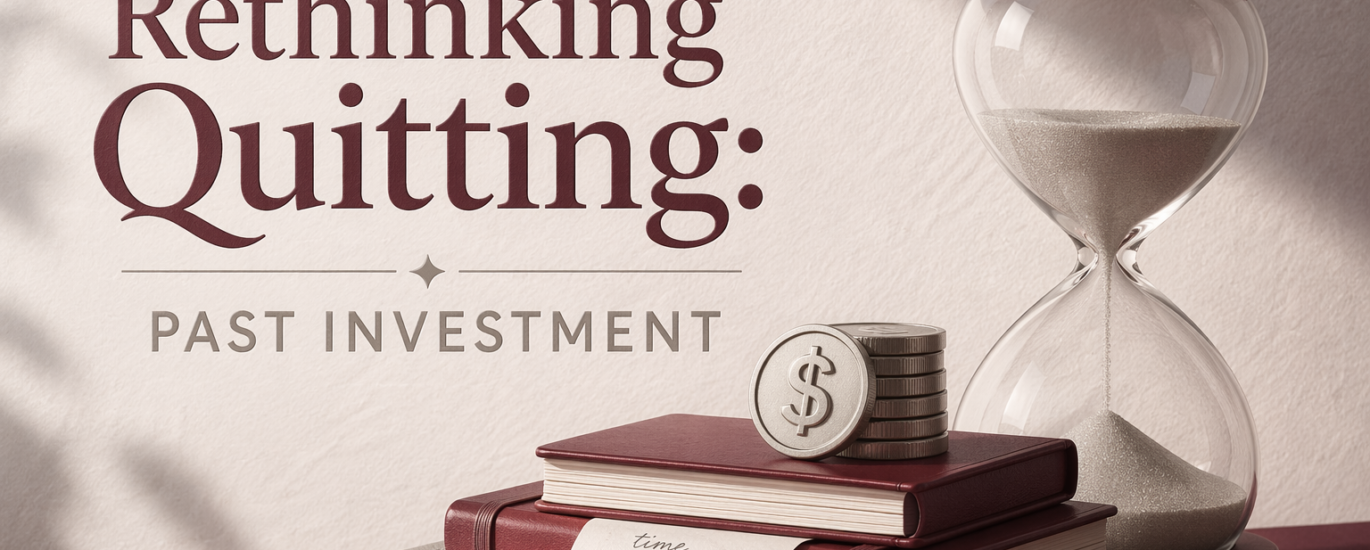
In my previous post, I shared that there are times when persistence may not be the best course of action. Quitting, or letting go, can create space for something new, or something more aligned with our current season. At the same time, we also recognize that the decision to quit can feel heavy. Think about a time when you were deciding whether to stay or walk away. Was that decision straightforward? Often, we observe, whether in others or ourselves, that we double or even triple down on something that isn’t working. This is called escalation of commitment.
So why is it so difficult to quit?
One of the major forces that shapes this decision is what I call past investment.
Think of a time when you told yourself, “I can’t walk away now. I’ve already invested too much time, money, and energy.” This is known as the sunk cost fallacy, a very common pattern in decision-making. You might have experienced it in simple ways, like finishing a movie you didn’t enjoy just because you paid for it, or because you’ve already watched this far. But logically, what you’ve already invested doesn’t have to determine what you do next. That investment is gone whether you continue or not. And continuing doesn’t necessarily recover what was spent or put things back on the “right path.” In the movie example, you’re not recouping anything, you’re just adding more time to something you already don’t enjoy. And unfortunately, the more we invest, the harder it becomes to walk away.
Part of this happens because we hate waste. We don’t want our time, money, energy, or effort to feel like it meant nothing. We want to feel like it mattered.
So instead of letting go, we keep going. Not always because it’s the right decision, but because stopping would make the loss feel real.
Another pattern that comes into play is the endowment effect. We tend to value what we own more simply because it’s ours. Imagine a home seller who believes their home should sell for more than the market suggests because of the updates they’ve made, the care they’ve put in, and the memories attached to it. And yet, if they were seeing the same home for the first time as a buyer, they might agree with the market value.
This doesn’t just apply to physical things. It applies to ideas, experiences, and businesses as well. Studies show that people are more willing to continue investing in a failing business if it was their idea, compared to evaluating the same situation objectively. We don’t want to let these things go because they feel valuable to us. Sometimes, we also want to prove that our original decision was right. Over time, the things we invest in don’t just feel valuable. They begin to feel like ours. And letting them go can feel like losing part of ourselves. We’ll explore that idea next.
In the meantime, I invite you to watch a video version of this topic for further reflection